Difference Between Serum and Moisturizer: The Complete Guide Your Skin Has Been Waiting For
You wash your face, pat it dry, then reach for your moisturizer — and wonder why your skin still looks dull, dehydrated, or uneven. You are doing the basics right, but something is missing.
Millions of people apply their skincare products in the wrong order or skip key steps entirely, unaware that serums and moisturizers serve completely different purposes. Using only one while ignoring the other is like eating well but never drinking water — one simply cannot replace the other.
Understanding the real difference between serum and moisturizer is the foundational knowledge your skin routine needs. Once you know how each product works, what ingredients to look for, and in what order to apply them, you will finally see the results that have been eluding you.
By the end of this article, you will know exactly what a serum does, what a moisturizer does, how they complement each other, and how to choose the right products for your specific skin type.
What You Will Learn in This Guide1. The core difference between serum and moisturizer — and why both matter
2. How each product works at different depths of the skin
3. The correct order to apply serum and moisturizer
4. Which products to choose for your skin type
5. Common mistakes that reduce effectiveness
What Is a Serum? Understanding the Basics
A serum is a lightweight, fast-absorbing skincare product formulated with a high concentration of active ingredients. Unlike a standard moisturizer, a serum is designed with a smaller molecular structure, which allows its active compounds to penetrate deeper into the skin rather than sitting on the surface.
Serums are typically water-based or oil-based, depending on their target concern. Their primary job is not to seal in moisture but to deliver a targeted treatment — whether that is brightening hyperpigmentation, fighting acne-causing bacteria, reducing fine lines, or stimulating collagen production.
Think of a serum as a concentrated dose of skincare medicine for your face. You use far less product per application (typically 2 to 4 drops), yet the impact can be significantly more powerful than thicker, occlusive products.
If you want to understand exactly what vitamin C serum benefits can do for your complexion, it helps to see serums not as a luxury step but as a precision delivery system for your skin's most important actives.
Key Characteristics of a Serum
Thin, lightweight consistency — gel, liquid, or light oil
High concentration of active ingredients (often 10 times more potent than a moisturizer)
Smaller molecular size for deeper skin penetration
Targets specific skin concerns rather than providing general hydration
Applied after cleansing and toning, before moisturizer
Usually requires only 2 to 4 drops per application
Common Types of Serums and Their Benefits
Serum Type | Key Ingredient(s) | Primary Benefit |
|---|---|---|
Vitamin C Serum | L-Ascorbic Acid | Brightens skin, fades dark spots, boosts collagen |
Hyaluronic Acid Serum | Sodium Hyaluronate | Deep hydration, plumping, smoothing fine lines |
Retinol Serum | Retinol / Retinoids | Anti-aging, cell turnover, reduces wrinkles |
Niacinamide Serum | Niacinamide (Vitamin B3) | Minimizes pores, controls oil, brightens |
AHA/BHA Serum | Glycolic, Salicylic Acid | Exfoliates dead skin, clears acne, improves texture |
Peptide Serum | Palmitoyl Peptides | Firms skin, stimulates collagen, reduces sagging |
Antioxidant Serum | Resveratrol, Ferulic Acid | Protects against environmental damage and free radicals |
Expert Tip: Mandelic Acid vs. Glycolic AcidNot sure which exfoliating acid belongs in your serum? Learning the difference between mandelic acid and glycolic acid can help you choose the right exfoliating active for your skin's sensitivity level and tone goals.
What Is a Moisturizer? The Skin Barrier Defender
A moisturizer is a skincare product designed to hydrate the outer layers of the skin and, critically, to lock that hydration in. Its primary role is to reinforce and repair the skin's natural barrier function — the protective shield that keeps moisture inside and environmental irritants outside.
Unlike a serum, a moisturizer typically has a larger molecular structure and a thicker, creamier texture. It is formulated with a combination of three key ingredient types: humectants (which draw water to the skin), emollients (which smooth and soften), and occlusives (which seal moisture in).
Moisturizers are suitable for all skin types, including oily skin. When the skin is stripped of moisture, it often overproduces sebum to compensate, leading to breakouts and greasiness. A well-formulated, lightweight moisturizer can actually help regulate oil production over time.
The Three Pillars of a Moisturizer
Humectants — Attract moisture from the air and deeper skin layers. Examples: hyaluronic acid, glycerin, and aloe vera.
Emollients — Fill gaps between skin cells to smooth texture and reduce roughness. Examples: ceramides, fatty acids, and squalane.
Occlusives — Create a physical barrier on the skin's surface to prevent water loss. Examples: shea butter, petrolatum, and dimethicone.
Types of Moisturizers by Formulation
Gel moisturizer — Lightweight, water-based. Best for oily and combination skin.
Lotion — Thinner oil-in-water formulation. Suitable for normal to slightly dry skin.
Cream — Balanced oil and water formulation. Good for dry to normal skin.
Balm or ointment — Heavy, oil-dominant formulation. Best for very dry or eczema-prone skin.
Sleeping mask — Overnight moisturizer with intensive repair ingredients. Good for all skin types needing a boost.
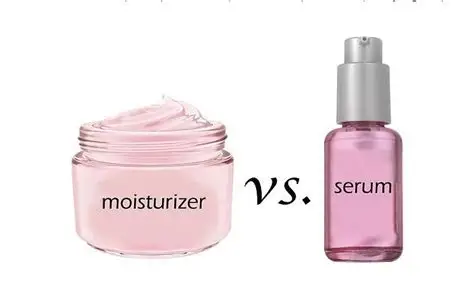
Difference Between Serum and Moisturizer: A Side-by-Side Breakdown
Now that you understand what each product does individually, let us look at the key differences between serum and moisturizer across the most important factors. This is the comparison most people need but rarely find laid out clearly.
Factor | Serum | Moisturizer |
|---|---|---|
Primary Purpose | Targeted treatment of specific skin concerns | Hydration and barrier protection |
Texture | Lightweight — liquid, gel, or light oil | Richer — lotion, cream, balm, or gel |
Molecular Size | Small — penetrates deeper layers | Larger — works on skin's surface |
Active Concentration | Very high (potent doses) | Low to moderate |
Main Ingredients | Retinol, Vitamin C, peptides, AHAs | Ceramides, shea butter, glycerin, hyaluronic acid |
Application Order | Step 3 — after toner, before moisturizer | Step 4 — after serum |
Amount Used | 2 to 4 drops per application | Pea-to-hazelnut-sized amount |
Skin Barrier Function | Does not reinforce the barrier | Reinforces and repairs the barrier |
Can Replace the Other? | No | No |
Price Point | Generally higher (more costly actives) | Generally more affordable |
"The difference between serum and moisturizer is not which one is better — it is that they each do a completely different job at different depths of the skin."
The most important takeaway from this comparison: neither product replaces the other. Used together, they create a complete skincare routine that addresses both treatment and protection simultaneously.
Living in a Specific Climate? Your Products Should MatchIf you live in Los Angeles or a similarly warm, urban climate, your serum and moisturizer choices should account for pollution exposure, UV intensity, and humidity levels. Read our guide to a skincare routine tailored to the Los Angeles climate to refine your product picks based on where you live.
Can You Use Serum Without Moisturizer — Or Vice Versa?
Using Serum Without Moisturizer
This is a common misconception, especially among people who think their serum is hydrating enough. While some serums — particularly hyaluronic acid serums — do add moisture, they do not lock it in. Without an occlusive or emollient layer on top, the water drawn into the skin by a humectant serum can actually evaporate into the air, leaving skin drier than before.
Skipping moisturizer after serum is especially problematic in dry or cold climates, in air-conditioned environments, and for anyone with a compromised skin barrier such as eczema, rosacea, or sensitive skin. Your serum's active ingredients also need a stable skin barrier to work optimally — and moisturizer helps maintain that stability.
Using Moisturizer Without Serum
This is far more common and significantly less problematic. Moisturizer alone can maintain healthy, hydrated skin if your skin does not have specific concerns to address. However, if you want to target issues like hyperpigmentation, acne, aging, or uneven texture, a moisturizer alone will not provide the concentrated active treatment those concerns require.
Think of It This WayMoisturizer is your daily maintenance. Serum is your specialized treatment. You can get by with maintenance alone — but treatment delivers results that maintenance simply cannot replicate.
The Correct Order to Apply Serum and Moisturizer
One of the most searched questions in skincare is whether serum goes before or after moisturizer. The answer follows a simple rule: apply products from thinnest to thickest consistency. This ensures each product can penetrate the skin effectively without being blocked by a heavier formula.
Full Morning Skincare Routine
Cleanser — Remove overnight sebum and bacteria.
Toner (optional) — Balance skin pH and prep for active ingredients.
Serum — Apply 2 to 4 drops, press gently into skin, wait 60 to 90 seconds.
Eye cream (optional) — Apply around the orbital bone before moisturizer.
Moisturizer — Seal in the serum and protect the skin barrier.
SPF 30 or higher — Non-negotiable final step every single morning.
Full Evening Skincare Routine
Oil cleanser or balm — Remove makeup, SPF, and pollutants.
Water-based cleanser — Deep-clean pores (double cleansing).
Chemical exfoliant (2 to 3 times weekly) — Improve cell turnover and texture.
Treatment serum — Apply retinol, peptide, or targeted night serum.
Moisturizer or sleeping mask — Intensive barrier repair overnight.
Face oil (optional) — Apply as the final step to lock everything in.
Wondering What to Expect From Professional Treatments?If you are building a home routine and considering adding a professional facial, read our guide on what to expect from your first facial and learn how to maintain your facial results at home using the right serums and moisturizers afterward.
Choosing the Right Serum and Moisturizer for Your Skin Type
The difference between serum and moisturizer choices matters most here. Each skin type benefits from a specific pairing of products. Using the wrong combination — even with perfect layering technique — limits your results.
For Oily and Acne-Prone Skin
Oily skin types often fear adding more product, but skipping both is a mistake. Choose a niacinamide or salicylic acid serum to control sebum and clear pores. Follow with an oil-free, non-comedogenic gel moisturizer that provides hydration without clogging pores.
Best serums: Niacinamide 10%, salicylic acid, zinc
Best moisturizers: Gel-based, oil-free, with hyaluronic acid and ceramides
Avoid: Heavy cream moisturizers, comedogenic oils such as coconut and cocoa butter
If hormonal breakouts are your main concern, our guide on how to treat hormonal acne will help you choose targeted serums and supporting skincare that works alongside your routine.
For Dry and Dehydrated Skin
Dry skin benefits enormously from a layered approach. A hyaluronic acid serum draws moisture deep into skin, while a rich cream moisturizer with ceramides and fatty acids locks it in. People with dry skin can also add a facial oil as the final step for extra occlusion overnight.
Best serums: Hyaluronic acid, squalane, peptides
Best moisturizers: Rich creams with ceramides, shea butter, glycerin
Avoid: Alcohol-heavy serums, matte-finish gel moisturizers
For Combination Skin
Combination skin requires balance. Use a lightweight serum across the whole face, but consider applying a richer moisturizer only to dry zones (cheeks, around the eyes) and a gel moisturizer on oily zones (T-zone). Multi-masking with different products by zone works well for serums too.
Best serums: Vitamin C, hyaluronic acid, niacinamide
Best moisturizers: Light lotion or zone-targeted application
For Sensitive and Reactive Skin
Sensitive skin types should look for fragrance-free, alcohol-free, and hypoallergenic formulas in both serum and moisturizer. Avoid high concentrations of acids or retinol until the skin barrier is strengthened.
Best serums: Centella asiatica, low-percentage azelaic acid, ceramide serum
Best moisturizers: Barrier-repair creams with ceramides, colloidal oatmeal, panthenol
Avoid: Fragrance, denatured alcohol, high-strength vitamin C or retinol initially
If redness and sensitivity are ongoing concerns, read our article on treating rosacea safely to understand which active serum ingredients are appropriate and which to avoid entirely.
Not Sure Which Products Are Right for Your Skin?A professional esthetician can assess your skin and recommend the right serum and moisturizer pairing for your specific concerns. Learn how to choose the best facial for your skin type and understand the role of professional treatments in supporting your daily routine.
Common Mistakes When Using Serum and Moisturizer Together
Mistake 1: Applying Moisturizer Before Serum
Because moisturizer is thicker and forms a partial barrier, applying it before your serum blocks the active ingredients from penetrating the skin. Always apply serum first on clean, lightly damp skin.
Mistake 2: Not Waiting Between Layers
Rushing through your routine and layering products immediately one after another reduces absorption. Give your serum at least 60 seconds to sink into the skin before applying moisturizer. For retinol serums, wait up to 2 to 3 minutes.
Mistake 3: Using Too Many Active Serums at Once
Layering multiple active serums — particularly those containing vitamin C, retinol, and AHAs simultaneously — can cause irritation, redness, and breakouts. Use one or two targeted serums at most, and separate potentially conflicting actives between morning and evening routines.
Mistake 4: Skipping SPF After Vitamin C or Retinol Serum
Both vitamin C and retinol make skin more sensitive to UV radiation. Always finish your morning routine with a broad-spectrum SPF 30 or higher. No matter how effective your serum is, sun damage will undo its benefits far faster than any product can repair them.
Mistake 5: Storing Vitamin C Serum in Sunlight
Vitamin C oxidizes when exposed to air and light, turning the serum orange or brown and rendering it ineffective. Store your serum in a cool, dark place and discard it when the color changes significantly.
Did You Know? Professional Facials Can Boost Serum AbsorptionTreatments like microcurrent facials and LED light therapy can enhance your skin's receptivity to active serums by improving cell function and circulation. These professional treatments pair powerfully with a well-designed at-home routine.
Serum vs. Moisturizer: Ingredients Glossary
Understanding ingredients helps you read labels and make smarter choices. Here is a quick reference glossary of the most common actives found in serums and moisturizers, including some powerful but underappreciated options.
Ingredient | Found In | What It Does |
|---|---|---|
Hyaluronic Acid | Serum and Moisturizer | Binds up to 1000 times its weight in water; deeply hydrates all skin types |
Retinol | Serum | Speeds cell turnover; reduces wrinkles and dark spots |
Niacinamide | Serum and Moisturizer | Reduces pores, controls oil, brightens and calms skin |
Vitamin C (L-Ascorbic Acid) | Serum | Antioxidant; brightens, protects, and boosts collagen synthesis |
Ceramides | Moisturizer | Restore and strengthen the skin's natural lipid barrier |
Glycerin | Moisturizer | Humectant; draws water into the skin from the environment |
Peptides | Serum and Moisturizer | Signal proteins to stimulate collagen and elastin production |
Squalane | Serum and Moisturizer | Lightweight plant-derived oil; conditions without greasiness |
Salicylic Acid (BHA) | Serum | Oil-soluble exfoliant; unclogs pores and prevents breakouts |
Centella Asiatica | Serum and Moisturizer | Soothes inflammation; speeds healing; supports barrier repair |
Saffron Extract | Serum | Powerful antioxidant; brightens skin and reduces hyperpigmentation |
Meristem Extract | Serum | Plant stem cell derivative; supports skin renewal and anti-aging |
Shea Butter | Moisturizer | Rich emollient; deeply nourishes dry and damaged skin |
Discover Two Powerful Serum IngredientsTwo ingredients worth adding to your radar: saffron's benefits for skin go far beyond the kitchen, offering antioxidant and brightening properties that rival well-known actives. And if you have never heard of it, learning what meristem extract is and how it supports skin renewal may change the way you shop for serums.
How to Build a Complete Skincare Routine Using Both
The ultimate goal is a routine that is consistent, layered correctly, and matched to your skin's unique needs. Here is a simple framework for building your ideal routine around the core difference between serum and moisturizer:
Step 1: Identify Your Skin Concerns
Before choosing a serum, identify your top one or two skin goals — brightening, anti-aging, acne control, or hydration boost. Choose your serum based on those specific goals. Your moisturizer choice should be based on your skin type, not your skin concern.
Step 2: Start Slowly
If you are new to using serums, introduce one at a time. Begin with the most tolerable options — hyaluronic acid or niacinamide — before moving on to potent actives like retinol or high-dose vitamin C. This reduces the risk of irritation and makes it easier to identify what works.
Step 3: Layer Correctly, Every Time
Morning and evening routines both benefit from the serum-then-moisturizer sequence. Make this second nature. The few extra seconds it takes to layer correctly pays off in measurable skin improvement within 4 to 8 weeks.
Step 4: Reassess Every Three Months
Your skin's needs change with seasons, age, stress, and hormonal shifts. Reassess your serum choice every three months. Your moisturizer formula may also need adjusting — lighter in summer, richer in winter.
Step 5: Protect What You Have Built
Every serum and moisturizer you invest in becomes meaningless without daily SPF. Sunscreen is the single most evidence-backed anti-aging product available. No serum — regardless of its price or formulation — can compensate for consistent unprotected sun exposure.
Want to Take It Further? Consider Professional TreatmentsYour at-home serum and moisturizer routine sets the foundation, but professional treatments can accelerate results. Explore whether microdermabrasion or microneedling is right for your skin, or discover the science behind how a radio frequency facial works to firm and tighten. For guidance on how often professional care belongs in your routine, read our article on how often you should get a facial.
Using Serum and Moisturizer to Target Hyperpigmentation
Hyperpigmentation — dark spots, melasma, and post-inflammatory marks — is one of the most common reasons people turn to targeted serums. The right serum ingredients can significantly reduce discoloration over time when combined with a protective moisturizer and daily SPF.
Key serum ingredients for hyperpigmentation include vitamin C, kojic acid, azelaic acid, tranexamic acid, and niacinamide. These work by interrupting melanin production at different stages. When paired with a moisturizer that supports barrier repair, they penetrate more effectively and cause less irritation.
For a broader look at this topic, our guide on reducing hyperpigmentation naturally explores how diet, lifestyle, and topical ingredients work together to even out skin tone over time.
Back Acne and the Serum-Moisturizer PrincipleThe difference between serum and moisturizer applies beyond your face. Body acne — particularly on the back and chest — responds well to the same logic: a targeted treatment (like a salicylic acid spray serum) followed by a lightweight, non-comedogenic body moisturizer. Learn more in our guide to back acne causes and solutions.
When to See a Professional About Your Skincare Routine
Home routines built around the right serum and moisturizer pairing deliver real results — but there are times when professional guidance adds enormous value. If you have tried multiple products without improvement, or if your skin concerns are severe (persistent cystic acne, stubborn melasma, or signs of rosacea), a professional assessment can pinpoint the exact actives your skin needs.
Understanding the difference between seeing an esthetician vs. a dermatologist helps you choose the right professional for your situation. An esthetician focuses on skin health optimization and treatment through facials, peels, and product guidance. A dermatologist handles medical-grade skin conditions and may prescribe prescription actives that outperform over-the-counter serums for certain concerns.
If you are in the Los Angeles area and looking for tailored professional guidance on facial treatments, our team can help you choose the right facial treatment in Los Angeles based on your exact skin type and concerns.
Advanced Treatments That Work Alongside SerumsSome professional treatments — particularly those that exfoliate or resurface — dramatically improve how deeply your serums absorb in the days following. Learn about the benefits and risks of chemical peels, the gentle power of Thermoclear treatment, and whether you can wear makeup after a facial — all questions that matter when combining professional care with your daily serum and moisturizer routine.
What the Research Says About Serum and Moisturizer Efficacy
The skincare industry is not just built on marketing — there is real science behind why serums and moisturizers work differently. Research published in peer-reviewed dermatology journals consistently supports the efficacy of layering targeted actives beneath occlusive or emollient formulas.
A comprehensive review in the Journal of the American Academy of Dermatology confirmed that topical antioxidants like vitamin C and ferulic acid show significantly better clinical outcomes when applied to a properly moisturized, barrier-intact skin surface. The barrier's integrity directly influences how well active ingredients perform.
The Skin Cancer Foundation's daily care guidelines also emphasize that SPF applied over moisturizer — and after any serum — forms the most effective final barrier against UV-induced damage that accelerates aging and cancels out the benefits of your active serums.
For those curious about what dermatologists recommend as a starting point for evidence-based skincare, the American Academy of Dermatology's skincare tips align closely with the layering principles outlined in this guide — reinforcing that the serum-then-moisturizer sequence is not a trend but a clinically sound practice.
Final Thoughts: Serum and Moisturizer Work Best as a Team
The difference between serum and moisturizer comes down to depth, concentration, and purpose. A serum dives deep and delivers a concentrated hit of active ingredients to treat your specific skin concerns. A moisturizer forms the protective umbrella on top, sealing in hydration and reinforcing your skin barrier.
Neither product is optional. Neither product can replace the other. Used together in the correct order, they create a skincare system that is far more effective than either product used alone.
Whether you are battling dark spots, dealing with persistent dryness, managing oily skin, or simply working to maintain a youthful and healthy glow — the right serum paired with the right moisturizer is the duo your skin has been waiting for.
Now that you know the difference, the only step left is choosing products matched to your skin's needs, applying them in the right order, and staying consistent. Clear, healthy, radiant skin is not complicated — it just requires understanding the tools you are working with.
Frequently Asked Questions
Is serum or moisturizer more important?
Neither is more important — they serve different functions. Moisturizer is essential for all skin types to maintain barrier health. Serum is essential when you have specific skin concerns to address. For a basic routine, start with a good moisturizer. For targeted results, add a serum.
Can I skip serum if my moisturizer contains hyaluronic acid?
You can, but the concentration of hyaluronic acid in most moisturizers is far lower than in a dedicated serum. If your only goal is general hydration, a moisturizer with hyaluronic acid may be sufficient. If you want deeper hydration or other targeted benefits, a serum will deliver them more effectively.
How long does it take to see results from a serum?
Most people begin to see early improvements in skin texture and tone within 4 to 6 weeks of consistent use. More significant concerns like deep wrinkles or stubborn hyperpigmentation may take 3 to 6 months of daily use to show visible change.
Can I use the same serum morning and evening?
Some serums, like hyaluronic acid and niacinamide, are suitable for twice-daily use. Others, like retinol and strong AHA serums, should only be used in the evening as they increase photosensitivity. Always check the product's directions and pair with SPF in the morning.
Do men need serums and moisturizers too?
Absolutely. Men's skin is generally thicker and oilier due to testosterone, but it still experiences dehydration, aging, sun damage, and barrier compromise. The same principles of layering serum before moisturizer apply equally regardless of gender.
What is the difference between serum and moisturizer for mature skin?
For mature skin, the difference becomes even more important. A peptide or retinol serum targets collagen loss and cell turnover, while a rich moisturizer with ceramides and fatty acids addresses the natural decline in skin lipids that comes with age. Using both is essential for mature skin to address multiple aspects of the aging process simultaneously.