What Is Microcurrent Facial? The Complete Guide to Nature’s Non-Surgical Facelift
Introduction: Your Skin Has a Power Problem
Your face is aging faster than you realize — and the culprit might not be what you think. Most people blame genetics or sun exposure, but one of the biggest hidden drivers of sagging, dull, and lined skin is something far more fundamental: a decline in your skin’s natural electrical activity.
Here’s the problem. As we age, the bioelectric signals that once kept our facial muscles toned and our collagen production humming begin to weaken. The result? Drooping jawlines, hollow cheeks, and a loss of the firmness that defined younger skin.
The solution is closer than you think. Microcurrent facial technology works with your body’s own electrical system to retrain muscles, stimulate collagen, and deliver visible lifting results — without a single needle or scalpel.
In this guide, you’ll learn exactly what is microcurrent facial therapy, how it works at a cellular level, who it’s best for, how it compares to other treatments, and how to make the most of it. Let’s plug in.
What Is Microcurrent Facial? Understanding the Basics
A microcurrent facial is a non-invasive cosmetic treatment that uses low-level electrical currents — measured in microamperes (μA) — to stimulate the muscles, skin tissue, and cellular processes of the face. The currents used are so gentle they fall below the threshold of sensation, mimicking the body’s own bioelectric signals.
The term “microcurrent” refers to the magnitude of the electrical current: one microampere equals one-millionth of an ampere. To put that in perspective, a typical household lightbulb uses about one million times more current than what is delivered to your skin in a microcurrent facial.
Originally developed in the 1980s to treat facial paralysis in medical patients, microcurrent therapy was quickly adopted by the aesthetics industry after clinicians noticed dramatic improvements in skin tone and facial contour as a welcome side effect.
The Science Behind What Is Microcurrent Facial Therapy
At the heart of microcurrent facial technology is a principle called bioelectricity. Every cell in your body produces and responds to electrical signals. These signals govern everything from nerve impulses to muscle contractions to cellular repair.
When it comes to facial aging, a critical decline occurs in ATP (adenosine triphosphate) production — the energy currency of your cells. Studies have shown that microcurrent stimulation can increase ATP production by up to 500%, directly energizing skin cells to perform repair and regeneration functions more efficiently.
Table 1: Key Microcurrent Facial Terms Explained
Term | What It Means |
Microcurrent | Electrical current measured in microamperes (μA), well below the threshold of feeling |
ATP (Adenosine Triphosphate) | The energy molecule that powers cellular activity; microcurrent can boost production by up to 500% |
Bioelectricity | Natural electrical signals produced and used by the body’s cells and tissues |
Galvanic Current | A type of direct current used in some microcurrent devices to enhance product absorption |
Facial Re-education | The process of retraining weakened facial muscles using electrical stimulus |
Collagen Stimulation | Triggering fibroblast cells to produce more collagen, improving skin firmness |
How Microcurrent Differs From Other Electrical Facial Treatments
Microcurrent is often confused with other electrical aesthetic devices, but important differences exist in terms of current strength, depth of penetration, and mechanism of action:
Treatment | Current Type | Intensity | Primary Effect |
Microcurrent Facial | Microcurrent (μA) | Sub-sensory | Muscle re-education, ATP boost |
TENS (EMS) | Milliampere (mA) | Visible muscle twitch | Muscle stimulation/contraction |
RF Facial | Radio Frequency | Thermal energy | Deep collagen heating |
Galvanic Facial | Direct current | Mild sensation | Product penetration, deep cleanse |
Electroporation | Pulsed current | Mild to moderate | Enhanced product delivery |
If you’re exploring other energy-based facial treatments, our guide on how radio frequency facial works provides an excellent comparison of how RF energy and microcurrent each target the aging process from different angles.
How Does a Microcurrent Facial Work? Step by Step
Understanding what is microcurrent facial treatment also means understanding what happens during a typical session. The process is methodical, targeting specific muscle groups and tissue layers in a deliberate sequence.
The Three Layers of Microcurrent Action
A well-performed microcurrent facial works simultaneously on three layers of the face:
1. Superficial Dermis — Stimulates fibroblast cells to produce collagen and elastin, improving texture and firmness.
2. Muscle Layer (SMAS) — Re-educates and tones the superficial musculoaponeurotic system, the muscular network that determines facial contour.
3. Cellular Level — Increases ATP production, enhancing cellular metabolism, hydration, and repair mechanisms.
A Typical Microcurrent Facial Session: What to Expect
Here is what a professional microcurrent facial session typically looks like from start to finish:
• Cleansing: The skin is thoroughly cleansed to remove all makeup, oil, and debris.
• Toning: A gentle toner or conductive gel is applied to prepare the skin and improve electrical conductivity.
• Conductive Gel Application: A water-based, conductive gel is applied generously. This gel serves as the medium through which microcurrent flows, ensuring smooth, even delivery.
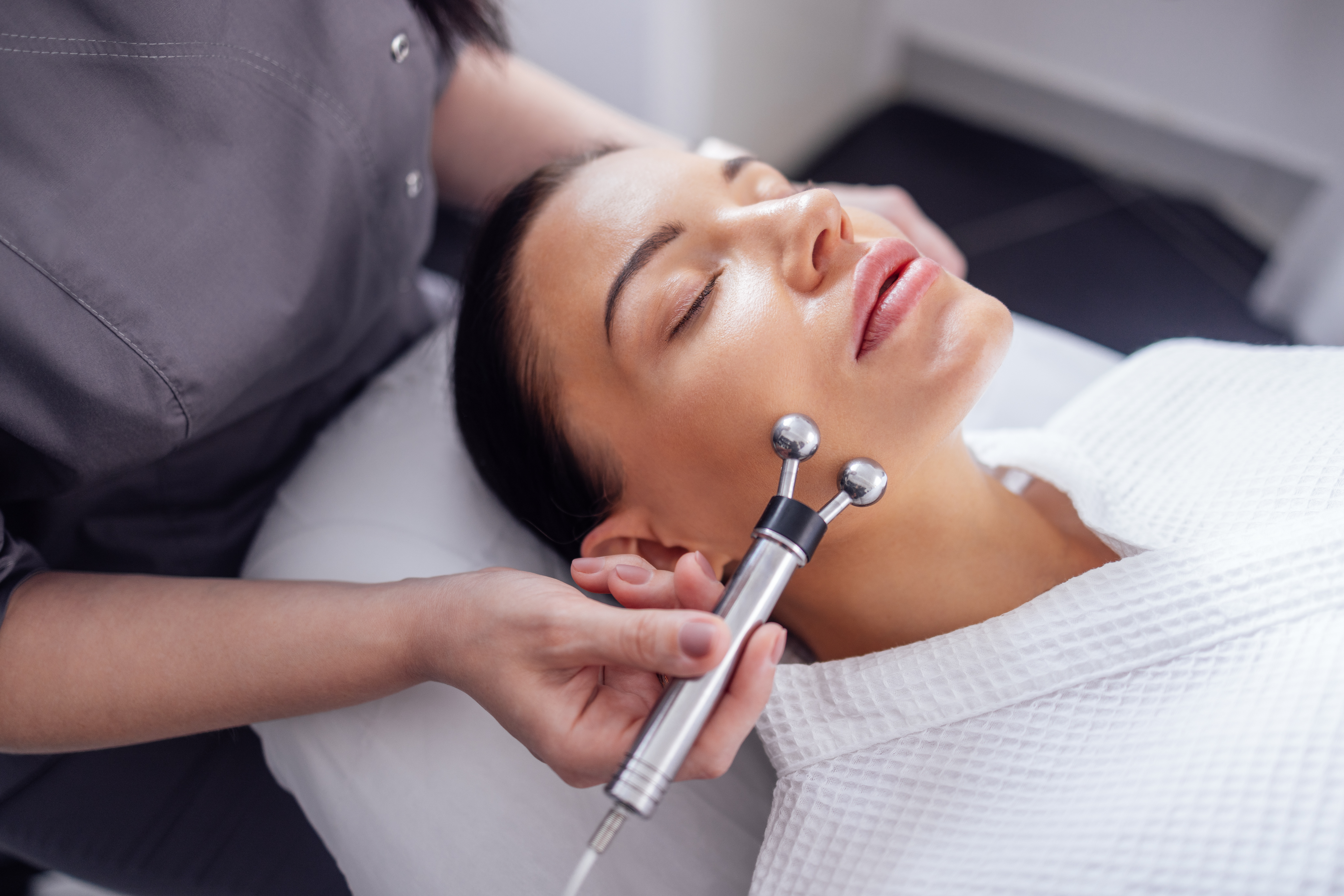
• Wand Application: A trained aesthetician or device user glides two metal prongs or wands across the face in specific patterns. Each pattern targets a different muscle group.
• Muscle Mapping: The wands move along defined vector lines that follow the natural muscle anatomy of the face — lifting brows, defining the jawline, smoothing the forehead.
• Serum Infusion (Optional): Some protocols incorporate the infusion of active serums (containing peptides, hyaluronic acid, or growth factors) during the treatment, leveraging the increased cellular permeability.
• Moisturizer and SPF: The session ends with a nourishing moisturizer and, in daytime appointments, broad-spectrum sunscreen.
What Is Microcurrent Facial Good For? Key Benefits
The benefits of microcurrent facial treatments are both immediate and cumulative. This dual-action makes it uniquely valuable among non-invasive options.
Immediate Benefits (Visible After a Single Session)
• Lifted brow and eye area
• Firmer, more defined jawline
• Smoother skin texture
• Brighter complexion due to increased circulation
• Reduced puffiness through improved lymphatic drainage
Cumulative Benefits (Visible After a Series of Treatments)
• Significant reduction in fine lines and wrinkles
• Improved facial symmetry
• Stronger, more toned facial muscles
• Longer-lasting collagen production
• Reduction in the depth of nasolabial folds and marionette lines
• Improved product absorption into skin
Table 2: Microcurrent Facial Benefits Overview
Benefit Area | Mechanism | Timeline |
Muscle Tone & Lift | Facial muscle re-education via electrical stimulus | Immediate + cumulative |
Collagen Production | Fibroblast stimulation, increased ATP | 4–6 weeks (series) |
Fine Line Reduction | Improved hydration + collagen remodeling | 4–8 weeks (series) |
Skin Radiance | Increased circulation + lymphatic drainage | Immediate |
Jawline Definition | Platysma & masseter muscle toning | 2–4 weeks |
Eye Area Lifting | Frontalis & orbicularis oculi re-education | Immediate + cumulative |
Product Penetration | Temporary increase in skin permeability | During treatment |
What Is Microcurrent Facial vs. Other Popular Treatments?
When considering what is microcurrent facial therapy and whether it is right for you, it helps to place it in context alongside other popular non-invasive and minimally invasive options.
For a deeper comparison of mechanical exfoliation treatments, check out our detailed guide on microdermabrasion vs microneedling to understand how surface-resurfacing treatments compare to energy-based lifting.
Table 3: Microcurrent Facial vs. Other Non-Invasive Treatments
Feature | Microcurrent | Chemical Peel | Microneedling | Botox |
Downtime | None | 3–7 days | 1–3 days | None |
Pain Level | Painless | Mild–Moderate | Mild | Mild sting |
Needle Required | No | No | Yes (micro) | Yes |
Results Duration | Weeks (maintenance) | Months | Months | 3–6 months |
Primary Target | Muscle + skin | Texture + tone | Scars + collagen | Wrinkles |
Collagen Boost | Yes | Yes | Strong | Indirect |
Suitable for All Ages | Yes | Mostly | 25+ | 25+ |
At-Home Option | Yes (devices) | Limited | Limited | No |
For those considering deeper skin resurfacing, our article on chemical peel benefits and risks explains how acid-based exfoliation can complement your microcurrent treatment plan.
Who Is a Good Candidate for a Microcurrent Facial?
One of the most appealing aspects of microcurrent facial therapy is its broad suitability. Unlike invasive procedures that require ideal skin conditions or health status, microcurrent is generally appropriate for a wide range of individuals.
Ideal Candidates for What Is Microcurrent Facial Therapy
• Adults of any age concerned about early or established signs of facial aging
• Individuals seeking a non-invasive alternative to surgical facelift or injectable fillers
• People with busy lifestyles who cannot afford downtime
• Those preparing for a special event and seeking immediate brightening and lifting
• Individuals using microcurrent as maintenance after injectables or other treatments
• Younger adults (20s–30s) using it proactively to delay the signs of aging
Who Should Avoid Microcurrent Facial Treatment
While microcurrent is safe for most people, there are specific contraindications to be aware of:
• People with pacemakers or any implanted electrical device
• Individuals who are pregnant
• Those with epilepsy or seizure disorders
• People with active skin infections, open wounds, or severe acne in the treatment area
• Individuals with a history of skin cancer in the treatment zone
• Those who have had recent surgical procedures or facial fillers (wait at least two weeks for fillers; consult a doctor post-surgery)
Professional vs. At-Home Microcurrent Facial Devices
The rise of consumer-grade microcurrent devices has made this technology more accessible than ever. However, significant differences exist between professional and at-home options that every informed consumer should understand.
Professional Microcurrent Facial Treatments
Professional devices used in medical spas and dermatology clinics deliver higher and more precisely calibrated microcurrent output. The trained practitioner follows specific muscle-mapping protocols, targeting each of the 32 facial muscles with a systematic approach that maximizes lifting and toning results.
Professional treatments typically last 60 to 90 minutes. An initial series of 6 to 10 sessions (performed 2 to 3 times per week) is usually recommended, followed by monthly maintenance sessions.
At-Home Microcurrent Facial Devices
Consumer microcurrent devices represent a fast-growing segment of the beauty tech market. Brands like NuFACE, BEAR by FOREO, and Ziip Beauty have popularized at-home options that deliver lower-intensity microcurrent suitable for daily use.
Table 4: Professional vs. At-Home Microcurrent Devices
Feature | Professional Device | At-Home Device |
Current Output | High (μA calibrated) | Low to moderate |
Session Duration | 60–90 minutes | 5–20 minutes |
Operator | Trained aesthetician | Self-administered |
Cost Per Session | $100–$400+ | One-time $200–$400 device |
Results Speed | Faster / more dramatic | Slower / gradual |
Customization | High (muscle mapping) | Limited |
Convenience | Appointment required | Use at home anytime |
How Many Microcurrent Facial Sessions Do You Need?
One of the most common questions people ask when learning what is microcurrent facial therapy is: how many treatments do I actually need to see results?
The answer depends on your age, skin condition, lifestyle, and goals. Here is a general framework:
Recommended Treatment Schedule
Goal | Phase | Frequency | Duration |
Initial Results | Introductory Series | 2–3x per week | 3–4 weeks |
Established Lifting | Active Treatment | 1–2x per week | 4–8 weeks |
Maintenance | Ongoing | Once per month | Ongoing |
At-Home Supplement | Daily use | Daily (5–10 min) | Ongoing |
Most clients see noticeable improvement after their first session — particularly in areas such as the jawline and brow. However, optimal and sustained results typically require completing a full initial series of 6 to 12 treatments.
Maximizing Results: What to Do Before and After a Microcurrent Facial
Before Your Microcurrent Facial
• Arrive with clean skin free of heavy makeup or creams
• Stay well hydrated — adequate internal hydration improves electrical conductivity
• Avoid harsh chemical exfoliants (AHA/BHA) for 24 to 48 hours prior
• Inform your aesthetician of any recent injectables, fillers, or skin treatments
• Avoid sun exposure or tanning 24 hours before your treatment
After Your Microcurrent Facial
• Apply a high-quality hyaluronic acid serum or peptide-rich moisturizer immediately after — your skin’s increased permeability will allow deeper penetration
• Avoid direct heat exposure (saunas, steam rooms) for 24 hours
• Wear broad-spectrum SPF 30+ if going outdoors
• Maintain skin hydration with a consistent skincare routine
• Avoid aggressive exfoliation for 24 to 48 hours post-treatment
Microcurrent Facial and Skincare: The Perfect Pairing
Understanding what is microcurrent facial therapy also means recognizing how it works synergistically with the right skincare ingredients. The temporary increase in cellular permeability that occurs during microcurrent treatment creates an ideal window for active ingredient absorption.
Best Skincare Ingredients to Use With Microcurrent
• Hyaluronic Acid — Provides deep hydration by drawing moisture into the temporarily more permeable skin
• Peptides — Signal proteins that support collagen synthesis and complement the ATP-boosting effects of microcurrent
• Vitamin C — An antioxidant powerhouse that supports collagen production and brightens skin tone
• Growth Factors — Powerful regenerative molecules that amplify the tissue-repair signals initiated by microcurrent
• Niacinamide — Improves skin barrier function and texture while reducing redness
Ingredients to Avoid During a Microcurrent Session
• Strong retinol or retinoids (use the night before or the night after, not directly before)
• Aggressive acid exfoliants (AHA, BHA, or TCA)
• Alcohol-heavy toners or astringents
What Does the Research Say About Microcurrent Facial Effectiveness?
Microcurrent has a solid body of clinical and scientific support. Research has consistently demonstrated its ability to increase cellular ATP production, accelerate protein synthesis, and improve wound healing — all of which translate directly to anti-aging benefits in aesthetic applications.
A foundational study published in Physical Therapy (Oxford Journals) demonstrated that microcurrent-level stimulation increased ATP production in soft tissue by up to 500% compared to unstimulated controls, validating the mechanism behind what is microcurrent facial therapy’s anti-aging effects.
The Journal of Clinical and Aesthetic Dermatology has published multiple studies confirming that low-level electrical stimulation can significantly increase collagen and elastin fiber production in treated skin, contributing to improvements in skin firmness and the reduction of fine lines.
While more large-scale randomized controlled trials are still needed, the existing body of evidence strongly supports the mechanisms behind microcurrent therapy, and millions of satisfied users around the world attest to its visible results.
Common Myths About Microcurrent Facial — Debunked
Myth 1: Microcurrent Facial Results Are Temporary and Superficial
While it is true that some of the immediate effects of a microcurrent facial (such as puffiness reduction) are short-lived, the cumulative benefits — including collagen stimulation and muscle re-education — are progressive and long-lasting with consistent treatment.
Myth 2: At-Home Devices Are Just as Powerful as Professional Machines
At-home microcurrent devices are excellent supplemental tools, but they operate at lower intensities than professional equipment. For significant lifting and contouring, professional sessions provide a much higher level of stimulation and cannot be fully replicated at home.
Myth 3: Microcurrent Is Only for Older Skin
While microcurrent facial treatments are particularly effective for addressing established signs of aging, they are increasingly popular as a preventative strategy among adults in their 20s and 30s. Starting early means maintaining muscle tone and collagen levels before significant decline occurs.
Myth 4: Microcurrent Hurts or Causes Burns
A properly performed microcurrent facial is entirely painless. The current levels are below the threshold of sensation. The only time discomfort occurs is when a device is used incorrectly, the skin is too dry (reducing conductivity), or the settings are inappropriate for the individual.
Microcurrent Facial Frequently Asked Questions
How long do microcurrent facial results last?
Initial results from a single session can last 48 to 72 hours. With a complete series of treatments, results typically last several months. Regular monthly maintenance sessions are recommended to preserve and build upon cumulative gains.
Can I combine microcurrent with other facial treatments?
Yes, in most cases. Microcurrent pairs well with hydrating facials, LED light therapy, oxygen facials, and gentle enzyme treatments. It is generally best to schedule microcurrent before or several days after more aggressive treatments such as chemical peels or microneedling.
Is microcurrent facial safe for sensitive skin?
Microcurrent is generally considered very gentle and is often recommended for sensitive skin as an alternative to more aggressive treatments. However, if your skin barrier is significantly compromised, it is advisable to consult with a dermatologist before beginning.
What is the difference between microcurrent and EMS (electrical muscle stimulation)?
EMS devices operate at milliampere levels — much stronger than microcurrent — and produce visible, forceful muscle contractions. Microcurrent, by contrast, is sub-sensory and works to re-educate and tone muscles gradually over time, rather than producing acute contractions.
How much does a microcurrent facial cost?
Professional microcurrent facial sessions typically range from $100 to $400 per treatment, depending on the clinic, location, and treatment protocol. At-home devices represent a one-time investment of approximately $150 to $400 and can be used indefinitely.
Final Thoughts: Is a Microcurrent Facial Right for You?
Now that you fully understand what is microcurrent facial therapy — from its origins in medical rehabilitation to its current status as one of aesthetics’ most beloved non-invasive treatments — you are in an ideal position to decide whether it fits your skincare goals.
What makes microcurrent truly remarkable is its ability to work with your body rather than against it. It does not paralyze muscles or inject foreign substances. It does not traumatize skin to force regeneration. Instead, it speaks to your skin in its own language — electricity — and gently reminds it of what it is capable of.
Whether you are exploring professional treatments at a medical spa or researching an at-home device for your daily routine, microcurrent facial therapy offers a safe, science-backed, and genuinely effective path to a lifted, firmer, and more radiant face.
Ready to explore more about how non-invasive energy treatments can transform your skin? Discover the science of how radio frequency facial works to see how combining RF with microcurrent can maximize your anti-aging results.