When you are considering a hair-restoration treatment, before-and-after results are usually one of the first things you want to see.
Can thinning areas actually look fuller? How soon could you notice a difference? How many appointments are required? And, perhaps most importantly, what counts as a realistic result?
Understanding Fusion Plasma Hair Restoration before and after changes requires patience because hair does not transform overnight. Scalp hair grows through a natural cycle, and visible changes in density can take months to assess properly.
At Aelita’s Beauty Services in Reseda, Los Angeles, Fusion Plasma Hair Restoration is offered as a non-surgical treatment designed to stimulate the scalp, support follicles and encourage thicker, healthier-looking hair. The current service page lists the treatment at $175 and references a package of eight sessions.
If you are considering a course of treatment, this guide explains what you may notice at each stage, how to assess progress and how aftercare and maintenance may influence your experience.
What Does Fusion Plasma Hair Restoration Do?
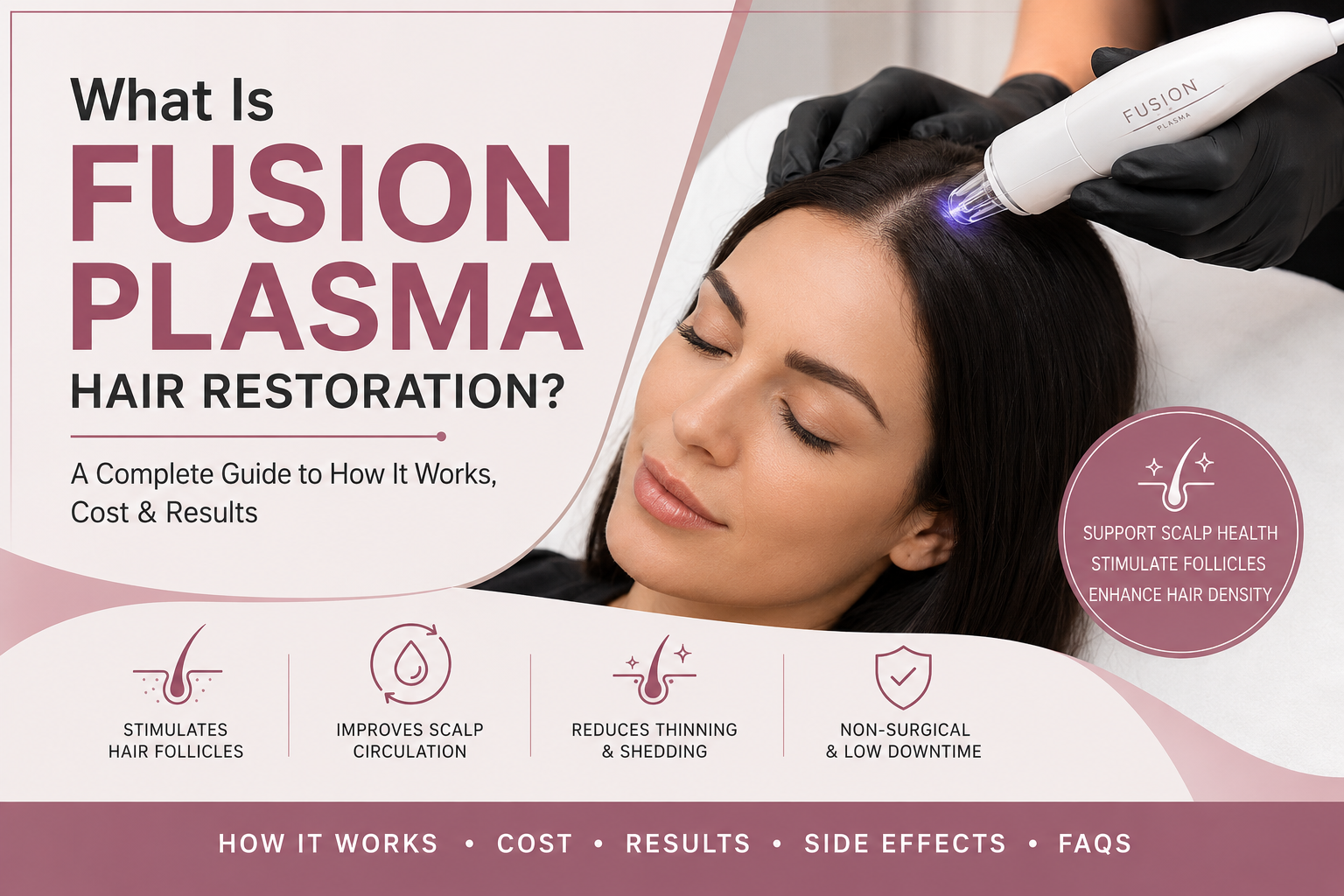
Fusion Plasma Hair Restoration uses plasma-based technology as part of a targeted scalp treatment. At Aelita’s Beauty Services, the treatment is intended to support scalp circulation and oxygenation, strengthen hair at the root, reduce the appearance of thinning and support fuller, healthier-looking hair.
Cold or non-thermal atmospheric plasma is also being investigated scientifically for its potential role in hair growth.
A small clinical pilot study involving 14 people with androgenetic alopecia found indirect cold-plasma treatment was well tolerated over three to six months, with most participants and investigators reporting improvement. Importantly, the researchers noted that the primary purpose of that study was tolerability rather than proving efficacy.
More recently, a 2025 study published in the Journal of the American Academy of Dermatology examined a cold atmospheric plasma device for hair growth, showing that clinical interest in the technology is continuing.
The evidence is encouraging, but Fusion Plasma should still be approached with realistic expectations rather than treated as a guaranteed cure for hair loss.
Fusion Plasma Hair Restoration Before and After: What Can Actually Change?
When comparing your scalp before treatment with your appearance afterwards, the goal is not necessarily to see a completely different head of hair.
More realistic changes may include:
Less noticeable scalp visibility through thinning areas
Hair appearing stronger or fuller
Improved appearance of overall density
Reduced appearance of excessive thinning
A healthier-looking scalp
Greater coverage from existing hair
The amount of improvement depends on your starting point.
Someone with early thinning and functioning follicles may have a very different experience from someone who has had a smooth bald area for many years.
Fusion Plasma is designed to support existing follicles. It should not be marketed as creating brand-new follicles where they no longer function.
That distinction is especially important when evaluating dramatic fusion plasma hair restoration results photos online.
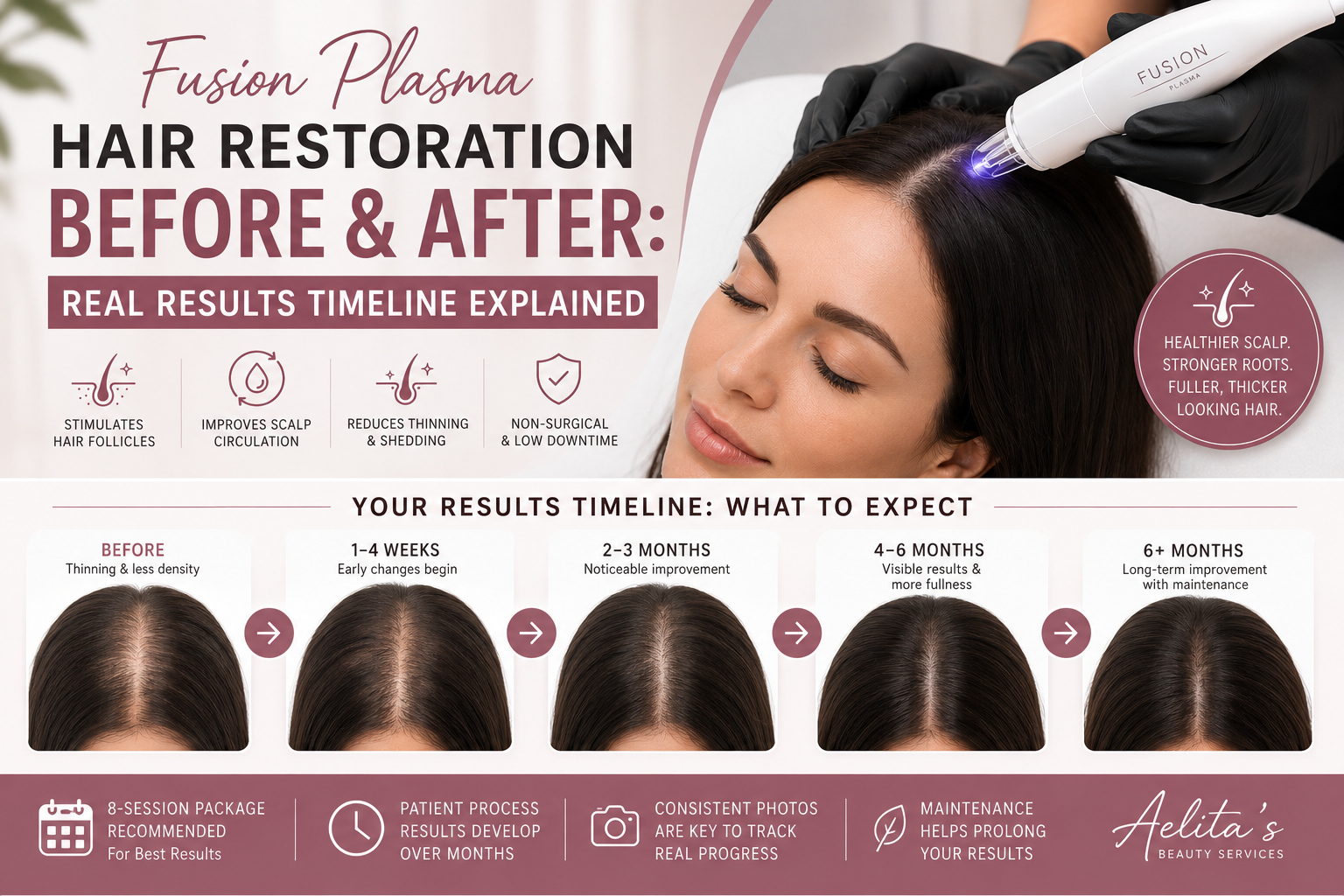
Fusion Plasma Hair Restoration Timeline: When Might You Notice Results?
Hair-restoration progress is better measured in months than days.
Human scalp hair typically grows around one centimetre per month, while individual follicles move through long growth, transition and resting phases. This is one reason meaningful before-and-after comparisons need time.
Here is a realistic fusion plasma hair restoration timeline.
Immediately After Your First Treatment
Do not expect noticeably thicker hair immediately after your first appointment.
The treatment is aimed at the scalp environment and follicles, so changes taking place beneath the surface will not instantly translate into longer or denser hair.
Depending on your individual response and the exact treatment protocol, your scalp may temporarily feel warm, sensitive or slightly irritated.
This early stage is about beginning the treatment programme rather than judging the final result.
Weeks 1–4: The Early Stage
During the first several weeks, visible density changes may still be minimal.
You may become more aware of how your scalp feels, how much hair you see when washing or brushing, and whether your hair appears stronger at the roots.
However, daily hair shedding naturally fluctuates. Avoid analysing your hair in the mirror every morning and assuming each change is caused by the treatment.
Consistent photography is far more useful.
Months 2–3: Early Progress May Become Easier to Assess
By the second or third month, some people may begin to feel that their hair looks healthier or that thinning areas appear somewhat less noticeable.
This should still be considered an early assessment point rather than the final result.
The 2020 clinical pilot of indirect cold plasma assessed people over three- and six-month treatment periods, illustrating why plasma-based hair interventions are studied over months rather than a few days.
Hair-loss treatments in general also take time. For comparison, the American Academy of Dermatology notes that even established treatments such as minoxidil may require six to twelve months before regrowth can be properly assessed.
Months 3–6: A Better Time for Before-and-After Comparison
This is often a more meaningful period for assessing whether your overall appearance is changing.
Look for differences in:
Scalp visibility
Coverage through the parting
Appearance around thinning areas
Hair calibre and strength
Overall fullness in photographs
Your practitioner may also compare your starting photographs with your current scalp.
The key is consistency. Photographs should be taken using the same hairstyle, lighting, camera angle and distance.
Six Months and Beyond: Review and Maintenance
By this stage, you and your practitioner should have a clearer picture of whether the treatment is meeting your goals.
Further sessions, maintenance or an alternative approach may then be discussed.
If thinning continues despite treatment, it may also be appropriate to speak with a dermatologist to identify whether genetics, hormones, medication, nutritional deficiencies, inflammation or another condition is contributing to your hair loss.
How Many Sessions of Fusion Plasma Hair Restoration Do You Need?
One of the most searched questions is “how many sessions Fusion Plasma Hair Restoration?”
There is no single universal number for every plasma system and every client.
Aelita’s Beauty Services currently references a package of eight sessions for its Fusion Plasma Hair Restoration service.
That does not mean everyone should expect identical results after appointment number eight. Your response can depend on the degree of thinning, how long it has been present, follicle condition, underlying cause of hair loss and consistency with treatment.
The spacing of your appointments should follow the protocol recommended by your practitioner rather than an arbitrary schedule found online.
How to Take Useful Fusion Plasma Hair Restoration Results Photos
Good fusion plasma hair restoration results photos are not simply attractive photographs. They need to make comparison possible.
For useful before-and-after images:
Take photographs before your first treatment.
Use the same room and lighting each time.
Keep the camera at approximately the same distance.
Photograph the same areas of the scalp.
Keep your parting in the same position.
Avoid using hair fibres or concealing products in comparison photographs.
Photograph wet hair consistently if wet-scalp images are being used.
Record dates so you know how much time has passed.
Hair length can create the illusion of improvement, while different lighting can make the scalp appear considerably more or less visible.
Consistent documentation gives you a much more reliable picture of progress.
Fusion Plasma Hair Restoration Realistic Expectations
Setting fusion plasma hair restoration realistic expectations is one of the most important parts of treatment.
A realistic goal may be improvement in the appearance of thinning and density rather than restoring every hair that has been lost.
Results are likely to vary considerably between clients.
The underlying cause matters too. Hair loss can result from hereditary pattern loss, stress-related shedding, medical conditions, inflammation, medication, hairstyles that create repeated tension and other factors. The American Academy of Dermatology recommends identifying the cause because different forms of hair loss require different approaches.
Sudden hair loss, circular bald patches, scalp inflammation, pain, scarring or unexplained rapid shedding should therefore be medically assessed rather than treated solely as an aesthetic concern.
Fusion Plasma Hair Restoration vs Competitor Treatment Options
When searching Fusion Plasma Hair Restoration vs competitor treatment options, you may encounter PRP, low-level laser therapy, minoxidil and hair transplantation.
They are not interchangeable.
Treatment | Approach | Downtime | Typical Consideration |
|---|---|---|---|
Fusion Plasma | Plasma-based scalp treatment | Generally limited | Non-surgical approach supporting scalp and existing follicles |
PRP | Concentrated platelets from your own blood are injected into the scalp | Usually minimal | Requires injections and repeated sessions |
Low-Level Laser Therapy | Light-based stimulation | Little to none | Often requires frequent, ongoing use |
Minoxidil | Topical or oral medication depending on medical advice | No procedural downtime | Continued use is generally required to maintain benefits |
Hair Transplant | Surgical movement of follicles | Greater recovery | More invasive but can provide permanent transplanted follicles |
The AAD notes that PRP typically requires repeated appointments, while laser therapy can require multiple treatments per week for months. Hair transplantation is a surgical option for suitable candidates and generally takes six to nine months before results become apparent.
The “best” treatment therefore depends on your diagnosis, goals, budget, tolerance for procedures and degree of hair loss.
Fusion Plasma Hair Restoration Recovery
Fusion plasma hair restoration recovery is one reason people may consider the treatment rather than a surgical procedure.
Because there is no hair transplantation involved, you are not waiting for donor and recipient sites to heal in the way you would after surgery.
Some people may experience temporary scalp sensitivity, warmth, redness or dryness after an aesthetic plasma treatment. Your practitioner should explain what is expected with the particular device and protocol being used.
Follow the instructions you receive rather than assuming every plasma system has identical recovery requirements.
Fusion Plasma Hair Restoration Aftercare
Proper fusion plasma hair restoration aftercare helps protect your scalp after treatment.
Your individual instructions may vary, but sensible aftercare generally means treating the scalp gently.
Avoid scratching or aggressively rubbing a sensitive treatment area. Use products recommended by your practitioner and avoid immediately introducing harsh chemicals or unfamiliar active products to an irritated scalp.
You should also tell your provider if you use prescription scalp products or medical hair-loss treatments so they can advise how these fit around your appointments.
If you experience an unexpected or persistent reaction, seek professional advice.
Does Skin Type Affect Fusion Plasma Hair Restoration?
People sometimes search for fusion plasma hair restoration skin type information because certain aesthetic procedures behave differently across skin tones.
For hair restoration, however, your scalp condition, hair-loss pattern, health history and treatment suitability may be more relevant than simply categorising yourself by skin type.
Your practitioner should assess the scalp before treatment.
Active infection, broken skin, unexplained lesions or significant irritation may require treatment or medical assessment first.
Never assume that because a treatment is non-surgical it is automatically appropriate for every scalp.
What Is the Best Age for Fusion Plasma Hair Restoration?
There is no universal best age for Fusion Plasma Hair Restoration.
Age alone does not tell you why someone is losing hair or whether their follicles are likely to respond.
A younger adult with early hereditary thinning may have completely different needs from someone experiencing temporary shedding after illness or a person with long-established advanced hair loss.
The more important questions are:
What is causing the thinning? How long has it been happening? Are follicles still present? Is the condition progressing? Are expectations realistic?
Hair loss can begin at many ages, so diagnosis and suitability matter more than choosing a particular birthday as the ideal time to start.
Fusion Plasma Hair Restoration Maintenance and Longevity
Fusion plasma hair restoration longevity is influenced by what caused the thinning in the first place.
Hair-loss tendencies do not necessarily disappear because you complete an aesthetic treatment programme.
For example, hereditary hair loss can continue progressing over time. The AAD similarly explains that benefits from treatments such as minoxidil require continued use, while ongoing hair loss can also affect the long-term appearance of hair-transplant results.
That is why fusion plasma hair restoration maintenance may be discussed after your initial course.
Maintenance should be personalised rather than automatically booked on an arbitrary timetable.
Your practitioner can review your photographs and scalp to decide whether continuing treatment makes sense.
Will You Need a Fusion Plasma Hair Restoration Touch Up?
A fusion plasma hair restoration touch up may be considered when a client has completed the initial programme and wants to support their results.
The frequency will depend on your individual response and the provider’s treatment protocol.
A touch-up should not simply be performed because a certain number of months have passed. Ideally, progress photographs and changes in shedding, density and scalp condition should guide the conversation.
Fusion Plasma Hair Restoration FAQ
Does Fusion Plasma Hair Restoration work after one session?
You should not expect dramatic hair-density changes after a single appointment. Hair grows slowly, so a course of treatment and adequate follow-up time are generally more appropriate for evaluating progress.
How many sessions does Aelita’s recommend?
Aelita’s current Fusion Plasma Hair Restoration page references a package of eight sessions. Your treatment schedule should be discussed during consultation.
When should I take my after photos?
Take baseline photographs before treatment, then repeat them at consistent intervals. Monthly images can document progress, while comparisons at around three and six months may be easier to interpret than daily photographs.
Are the results permanent?
No responsible provider should guarantee permanent results. Longevity depends partly on the underlying cause of your thinning and whether hair loss continues.
Can Fusion Plasma restore completely bald areas?
It should not be presented as a way to create entirely new follicles in areas where follicles are no longer viable. Advanced hair loss may require dermatological or surgical assessment.
Can I combine Fusion Plasma with other hair treatments?
Possibly, but combination treatment should be personalised. Tell your practitioner about topical products, prescription medication, supplements and other scalp treatments before starting.
Start Your Fusion Plasma Hair Restoration Journey at Aelita’s Beauty Services
The most useful Fusion Plasma Hair Restoration before and after comparison is not a dramatic internet photograph. It is a consistent record of your own scalp taken over enough time to judge genuine change.
Hair restoration requires patience. Because follicles work through natural growth cycles, meaningful improvements should be assessed progressively rather than expected immediately.
At Aelita’s Beauty Services in Reseda, Los Angeles, Fusion Plasma Hair Restoration is currently offered for $175, with an eight-session package referenced on the service page. The treatment is designed to support scalp health, follicle activity and fuller, healthier-looking hair.
If you are ready to explore whether Fusion Plasma is suitable for your thinning concerns, contact Aelita’s Beauty Services to arrange a consultation and discuss your personalised treatment plan.